

Road networks around the globe are creaking under the pressure of climate change. Many effects that were once considered risks and concerns of the future, warmer temperatures, heavier rains, and more frequent floods, and more extreme weather, are now here. Flash floods, flooding highways, heatwaves, crumbling pavements, and storms washing away rural roads are disrupting trade, mobility, and emergency relief systems.
As a result, ‘Climate-Resilient Roads’ has become a strategic imperative for governments, engineers, and technology providers to the infrastructure industry. Instead of repairing damage in the wake of disasters, transport authorities are moving toward a more proactive kind of planning, envisioning roads that can survive climate risks even as they remain safe, dependable, and cost-effective throughout their life cycles. But this is not just better materials; it is a sweeping move toward climate-resilient infrastructure that combines sustainability, data-driven planning, and decades-long asset operations.
This blog captures what Climate-Resilient Roads are all about, how they are transforming the face of 21st-century transport, and the cutting-edge technologies and policies that are making this happen, as well as why future-ready road infrastructure investment is crucial for resilient economies and societies.
We will look into
- What Are Climate-Resilient Roads and Why They Matter
- The Rising Threats Facing Global Road Networks
- Designing Roads for Climate Adaptation and Longevity
- Materials and Technologies Powering Climate-Resilient Roads
- Building Sustainable Transport Infrastructure at Scale
- Policy, Planning, and Asset Management for Resilient Roads
- Global Examples of Climate-Resilient Road Infrastructure
- The Economic and Social Benefits of Climate-Resilient Roads
- The Future of Climate-Resilient Roads
- FAQs About Climate-Resilient Roads
What Are Climate-Resilient Roads and Why They Matter

Understanding road climate resilience forms the basis for policy decision-making, engineering design, and digital infrastructure planning. With increasing climate risks, the question of being resilient is no longer an option but has become an essential requirement for the transport infrastructure to perform efficiently and safely.
Key Takeaways
- Climate-Resilient Roads are infrastructure assets that would become mandatory – not extras, as extreme weather events and climate volatility continue to wreak havoc on transportation systems, public safety, and economic activity.
- Prevention is better than cure, and with climate-resilient infrastructure.
- With climate-resilient roads, long-term costs will be lower, service disruptions will be fewer, and your road assets will have a longer life.
- Data, digital tools, and Industry 4.0 technologies are also the key enablers of road infrastructure resilience, as they enable authorities to evaluate climate risks, make investments for resilience a priority, and utilise resources more smartly.
Defining Climate-Resilient Roads in Modern Transport Planning
Climate-Resilient Roads are planned, constructed, and maintained to endure the effects of long-term climate change without loss of function or safety. Unlike most roads that are built to historical weather patterns, a climate-resilient road takes into account future forecasts of weather, such as more extreme precipitation, temperature variance, and extremes in local climatic conditions.
Such a proactive approach allows transport authorities to positively influence the asset lifecycle of failure risks.
For the transportation authorities and engineers, resilience is about more than structural strength. That list ranges from adaptive drainage regimes to climate-friendly materials, and ways of maintaining a playing surface adaptable to the designer’s plans, data analytics.
Climate adaptation also increases the need for digital tools to assist with planning, monitoring, and predictive maintenance of infrastructure providers. At this juncture, roads that are resilient to climate prevent premature failure or loss of public investments while maintaining transport service continuity and promoting economic stability.
The Link Between Climate Change and Road Infrastructure Failures
The impact of climate change and road infrastructure is becoming evident in developed and developing countries.
Roads are exposed assets and commonly cross floodplains, coasts, and mountain areas that can be subject to landslides. Plus, sea level rise is causing roads near the coast to erode, and pavement is cracking and sagging in extreme heat.
Further, flooding is still one of the most destructive risks. As we know, heavy rainfall results in clogged drains, road substructure fails, followed by long closures.
Heatwaves, meanwhile, soften asphalt and rut, posing safety risks. These failures are indicative of the limitations in design standards; they reveal the necessity for resilient road infrastructure to climate and not simply designed according to historical averages.
The Rising Threats Facing Global Road Networks
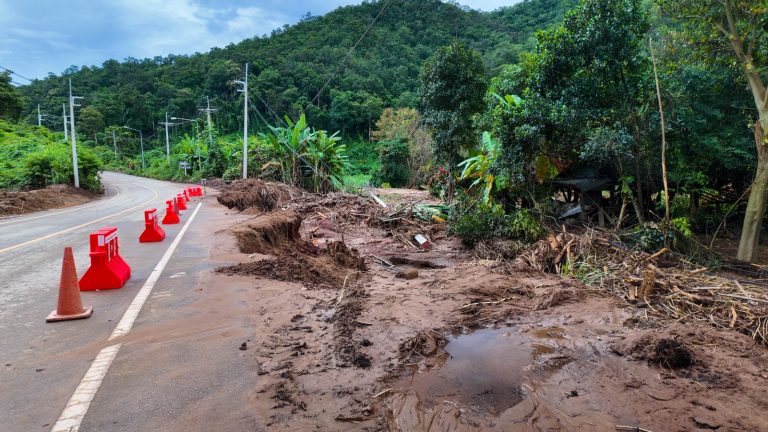
The real problem is that climate risks are outpacing infrastructure renewal cycles. Transport arteries planned decades ago have been operating beyond their initial design assumptions and are increasingly susceptible to widespread disruption and damage.
Flooding, Heatwaves, and Storm Damage on Roads
Flooding is a hugely damaging process for road networks currently. This is where flood-resistant road design is an integrated approach that takes into account the drainage capacity of the pavement, elevation, and surface penetrability.
In cities, authorities utilise roads to convey water during heavy precipitation and hence play an essential role in the city-scale flood mitigation. Embedding urban flood mitigation through road design enables transport planners to eliminate water accumulation but also minimise the encroachment of present communities.
Moreover, heatwaves present a different challenge. Higher temperatures accelerate pavement ageing, add to maintenance costs, and reduce safety.
It is visible that debris buildup and structural damage are exacerbated by storms and high winds. Taken together, these climate threats require road designs capable of withstanding shocks, bouncing back swiftly, and operating under extreme conditions.
Why Traditional Road Design No Longer Works
Current road planning guidelines are more or less based on climate developments and assume that weather patterns will not be disrupted to the extent we have recently seen. But in an age of climate volatility, that no longer stands.
This is why authorities need new approaches for extreme weather road design to cope with climate conditions that combine climate projections, risk assessment, and adaptive engineering.
Those traditional materials and drainage systems are frequently inadequate to cope with sudden heavy rain or long periods of hot weather. The roads break down more often, and costly repairs are needed.
For governments and infrastructure operators, this reactive cycle drives up long-term costs while eroding trust. At this point, ditching old criteria is the key to achieving road infrastructure resilience.
Designing Roads for Climate Adaptation and Longevity
Building roads to better withstand climate change involves integrating considerations for adaptation at every stage of planning and construction, from early feasibility studies to long-term strategies for maintenance.
Engineering Principles Behind Resilient Road Infrastructure
At the heart of resilient road infrastructure are engineering principles that emphasise robustness, flexibility, and risk mitigation. That would mean constructing stronger bases, increasing drainage capacity, and selecting materials that are suitable for the nation’s climate.
What is more, elevation modification, slope stabilisation, and control of erosion are very important in the flood-prone hilly areas.
For engineers, resilience means taking a systems-based approach to how roads interact with surrounding landscapes and other structures. For governments, it indicates enacting performance-based standards rather than prescriptive rules.
These guiding principles ensure that road networks are not fixed and can be adjusted to different conditions, yet provide the same service level at any point in time.
Integrating Climate Adaptation in Transport Projects
Integrating climate adaptation in transport projects starts early in project planning. By conducting a climate risk assessment for roads, the transportation authorities will be able to identify these weak points and prioritise interventions before construction.
Not to mention this forward planning minimises future disruption and increases cost effectiveness.
Here is where defensive measures, such as realignment of routes, an increase in the capacity of drainage culverts, or redundancy in vital transport links, are employed. This presents an opportunity for infrastructure companies to deliver decision-support platforms that utilise climate data, asset performance metrics, and predictive analytics.
Aligning transport investments with climate adaptation objectives can enable stakeholders to build future-proof infrastructure that works and is safe in an uncertain tomorrow.
Materials and Technologies Powering Climate-Resilient Roads
As we can see, materials science and construction technologies are pushing the envelope in order to make roads that can better serve the environment during inclement weather.
Smarter Materials for Extreme Conditions
There is no argument that innovative materials are crucial to developing future-ready road infrastructure. These Heat-resistant road materials can resist heat deformation, which reduces maintenance needs in hot regions.
The improvements in safety and pavement life are achieved with the materials described above under increasing thermal stress.
Meanwhile, services such as permeable pavement systems enable water to flow through the road surface, which would reduce runoff and help flood defences. Such systems are well-suited to urban areas, where impervious surfaces give rise to waterlogging.
It is evident that smarter materials that offer both performance and resilience help road networks adjust to climate extremes.
Nature-Based and Low-Carbon Construction Approaches
Green infrastructure, such as NBS, is emerging as a cost-effective and sustainable option for strengthening urban resilience. Also, these nature-based solutions for roads feature vegetated swales, green embankments, and restored wetlands that suck up excess water and steady the ecosystem around them. Such interventions build resilience and provide environmental co-benefits.
This also maximises the reduction of emissions in construction. Low-carbon road construction seeks to reduce embodied carbon in construction by using recycled materials, energy-efficient processes, and creative design.
Together, these strategies help fulfil climate objectives while also enhancing road performance under future conditions.
Building Sustainable Transport Infrastructure at Scale

You need to scale up the adaptation if it is going to have a substantial impact. However, you need to keep in mind that building resilience into individual projects is not sufficient; you need to incorporate it into entire transport systems.
Aligning Road Projects with Climate and Sustainability Goals
Developing sustainable transport infrastructure is now in search of coherence between transport planning, climate policy, and environmental goals. By incorporating green infrastructure in transport, we can help make roads work for nature and be part of the solution to overall sustainability targets, such as biodiversity conservation and cutting carbon.
Governments are a key part of this picture with robust policy frameworks and funding mechanisms that prioritise resilience. For engineers in your construction company, those projects that align with these goals open up opportunities that result in integrated solutions.
Plus, they are relevant to the future and can satisfy regulations and environmental demands.
Creating Resilient Transportation Systems for Cities and Regions
Beyond the specific assets, countries and city councils around the globe need resilient transportation systems to stay in communication during times of trouble. This includes redundancy in the design of networks as well as securing critical corridors and rapid restoration in response to an extreme event.
This is the moment when system resilience will boost financial stability, favour emergency measures, and enhance public confidence. Real-time monitoring and insights are more important than ever for effectively managing these networks, with digital tools that facilitate both now being critical.
Policy, Planning, and Asset Management for Resilient Roads
It is always within policy and governance regimes that climate resilience becomes incorporated into road networks.
Government Policies Driving Climate-Resilient Road Development
It is indeed a promising fact that across the globe, governments are embedding resilience into transport strategies via revised design guidelines, climate adaptation planning, and financing mechanisms. They provide incentives for road infrastructure climate adaptation by driving investment decision-making towards long-term performance and risk reduction.
Clear policy direction is what allows engineers and tech providers to innovate with confidence. It also guarantees that resilience is integrated more uniformly throughout the national and regional road networks, rather than in a patchwork manner.
Managing Road Assets Under Climate Stress
We all know that asset management is crucial when it comes to climate change. Road asset management under climate change focuses on monitoring performance, determining priorities for maintenance, and planning the renewal of these assets based on risk and value.
If we were doing life-cycle cost analysis for roads, it would enable comparison of current spending plans with potential savings in long-term maintenance and delay costs.
Increasingly, for construction companies in Australia and around the world, asset management platforms that overlay climate data and predictive analysis are becoming the tools of choice when responding to abrupt events driven by resilience.
Global Examples of Climate-Resilient Road Infrastructure

These examples from the real world simply indicate how the concept of resilience translates to practical achievements.
Flood-Resilient Roads in Coastal and Urban Regions
It has become a trend that many countries are building disaster-resilient transport corridors to shield important routes from floods and storms. Did you know this?
Flyovers, bunds, and flexible drainage systems are just some examples of effective measures taken to keep roads serviceable even during the most severe events.
These projects demonstrate the importance of combining engineering know-how with policies that support long-range planning to achieve resilient results for communities and economies.
Lessons from Countries Investing in Future-Ready Roads
When investing in road infrastructure resilience, we can see that countries show significantly lower recovery costs and shorter post-disaster restoration. Their accounts illustrate the need for forward-thinking investment, multi-sector cooperation, and ongoing innovation in future-ready road infrastructure.
The Economic and Social Benefits of Climate-Resilient Roads
Beyond engineering achievements, climate-resilient roads have broad economic and social impacts. Let’s explore them in the sections below.
Reducing Long-Term Costs and Disruptions
Though climate-resilient roads may be more expensive to create initially, it is also true that they save significant money in the long run by avoiding repair, closure, and emergency spending. For governments, it means better value for public money and more certainty on infrastructure budgets.
Supporting Communities, Trade, and Emergency Access
No doubt that good roads are crucial to social inclusion, trading, and disaster management. At this juncture, climate-resilient roads secure the means to make a living, do business, and improve public safety and amenity by maintaining access during the worst of weather.
The Future of Climate-Resilient Roads
Road maintenance tools and techniques must continue to evolve as climate risks change.
Innovation, Data, and Smarter Infrastructure Planning
For Climate-resilient roads, the future rests on incorporating new technologies, data, and digital intelligence into planning and operations. This is where predictive analytics, digital twins, and climate-aware decision-support systems support an approach that is proactive and that continues to learn.
For governments, engineers, and infrastructure construction companies, the adoption of these tools clears the road to enable resilient, sustainable, and future-proof transport networks as conditions become less predictable.
Tigernix Smart Transportation Asset Management Solution
Tigernix Smart Transportation Asset Software is an Industry 4.0-enabled platform to help governments and transport authorities in rolling out climate-resilient roads at scale. Employing advanced analytics, IoT data, and digital intelligence, Tigernix empowers early infrastructure planning and stimulates adaptive response to weather patterns.
The platform enables road infrastructure climate adaptation by integrating asset performance data with climate risk observations, enabling authorities to prioritise upgrades, optimise maintenance intervals, and lower costs in the long term. Using predictive analytics and a lifecycle-oriented plan, the Tigernix solution builds sustainable, resilient road infrastructure that meets the requirements of sustainability and resilience guidelines.
Tigernix serves as the centralised hub to keep engineers organised when managing intricate road networks. For those in decision-making roles, it provides actionable intelligence that ties infrastructure investment to resilience, sustainability, and public safety objectives, serving as a key enabler of future-ready road infrastructure within an increasingly volatile climate.
Call for a free demo.
Tigernix-All Road Assets Under One Screen.
Is Climate-Resilient Road the Future of Transportation?
Climate-resilient roads are not just something we aspire to in the future – they are what is necessary here and now for transportation, economy, and safety. With climate risks rising, transport authorities cannot continue business as usual by repairing the past; they need to manage for data-driven planning, adaptive design, and long-term asset optimisation.
By applying robust engineering with smart AM and I4.0 solutions, governments and infrastructure owners can create road networks that are not just durable – they are future-ready!
FAQs About Climate-Resilient Roads
The five pillars of climate resilience typically include risk assessment, adaptive planning, resilient design and infrastructure, effective governance, and continuous monitoring and improvement. Together, these pillars help governments and infrastructure owners anticipate climate risks, reduce vulnerability, and ensure long-term system performance under changing environmental conditions.
Climate resilience refers to the ability of systems, infrastructure, or communities to anticipate, withstand, adapt to, and recover from climate-related shocks and stresses such as flooding, heatwaves, or extreme weather. In infrastructure, it means designing and managing assets to remain functional and safe despite long-term climate change impacts.
Examples of climate resilience include flood-resistant roads, heat-tolerant building materials, coastal protection systems, climate-adaptive drainage networks, and resilient transportation systems that maintain connectivity during extreme weather events. These measures reduce disruption, protect investments, and enhance long-term sustainability across infrastructure networks.
Climate-resilient design is an approach that integrates future climate risks into planning, engineering, and construction decisions. It involves using climate data, adaptive materials, and flexible design standards to ensure infrastructure can withstand extreme weather, reduce long-term damage, and perform reliably throughout its lifecycle.